
What if Dominos Aren't Just for Games and Biscuits Are More Than Snacks? Why Your Furniture Might Not Last as Long as You Think
The Question I Hear All The Time
"I saw this beautiful table online for $300. Can you make it for less?"
My answer is always the same: No. And here's why that matters to you.
As a small artisan woodworker, I don't compete on price—I compete on something far more valuable: pieces that your grandchildren will fight over someday. But here's the thing most people don't realize when they're shopping for furniture or home decor: not all wood joining is created equal, and that difference determines whether your investment lasts five years or fifty.
Let me tell you a story about dominos and biscuits. No, not the kind from game night or breakfast—the secret engineering that separates heirloom-quality furniture from pieces that end up on the curb in a few years.
What Most People Don't Know About How Wood Stays Together
Picture this: You've just bought a beautiful dining table. Multiple pieces of wood joined together to create that gorgeous top. It looks perfect in your dining room. But here's the question almost nobody asks: How is that wood actually held together?
Most people assume it's just glue. And sometimes, unfortunately, they're right—that's exactly why the table starts wobbling after a year or separates at the seams after two.
Wood is a living material. Even after it's been cut and shaped, it still moves. It expands when humid, contracts when dry, and constantly shifts with the seasons. That's not a flaw—that's nature. But it means the method used to join wood pieces together makes all the difference between furniture that lasts and furniture that fails.
For over 35 years, I've been refining how I create pieces that stand the test of time. And two techniques have revolutionized my work: biscuit joinery and domino joinery. Let me show you why these matter to you as a buyer.
The Table Top That Stayed Perfect: Understanding Biscuit Joints

Custom Bench by Grayhill Woodworking LLC
Last year, a customer commissioned a custom desk table top. He wanted a large tabletop made from multiple boards of reclaimed wood—each piece with its own character, grain patterns, and story. Beautiful vision. But here's the challenge: when you glue multiple boards side-by-side to create a wide surface, keeping everything perfectly flat and aligned during assembly is incredibly difficult.
Without the right technique, you end up with boards that shift up or down, creating an uneven surface with lips and ridges. You know that table where your wine glass doesn't sit quite flat? That's poor alignment during glue-up.
This is where biscuit joinery comes in. Think of biscuits as small, football-shaped wafers made from compressed wood. I cut matching slots into the edges of the boards I'm joining, insert these biscuits with glue, and clamp everything together. The biscuits absorb moisture from the glue and expand, creating a tight fit that—most importantly—keeps every board perfectly aligned as one flat surface.
Here's what you need to know: Biscuits aren't about making the joint stronger. They're about precision. They ensure that when you run your hand across that tabletop, it feels like one seamless piece of wood, not multiple boards cobbled together. That customer's table? Years later, it still looks and feels as perfect as the day he received it.
For items like serving trays, charcuterie boards, and decorative panels where alignment and a smooth surface matter more than supporting heavy structural weight, biscuit joinery is my go-to technique. It's a method I embraced decades ago because it lets me create flawless surfaces while maintaining efficiency—which means I can focus more energy on selecting beautiful wood and perfecting the details that make each piece unique.
The TV Stand That Never Wobbles: Understanding Domino Joints
Now, let's talk about a different challenge: structural strength.
A few years ago, I started building small furniture pieces—TV tables, side tables, small cabinets. These aren't just decorative; they need to support real weight and withstand daily use for decades. This is where traditional craftsmanship meets modern innovation.
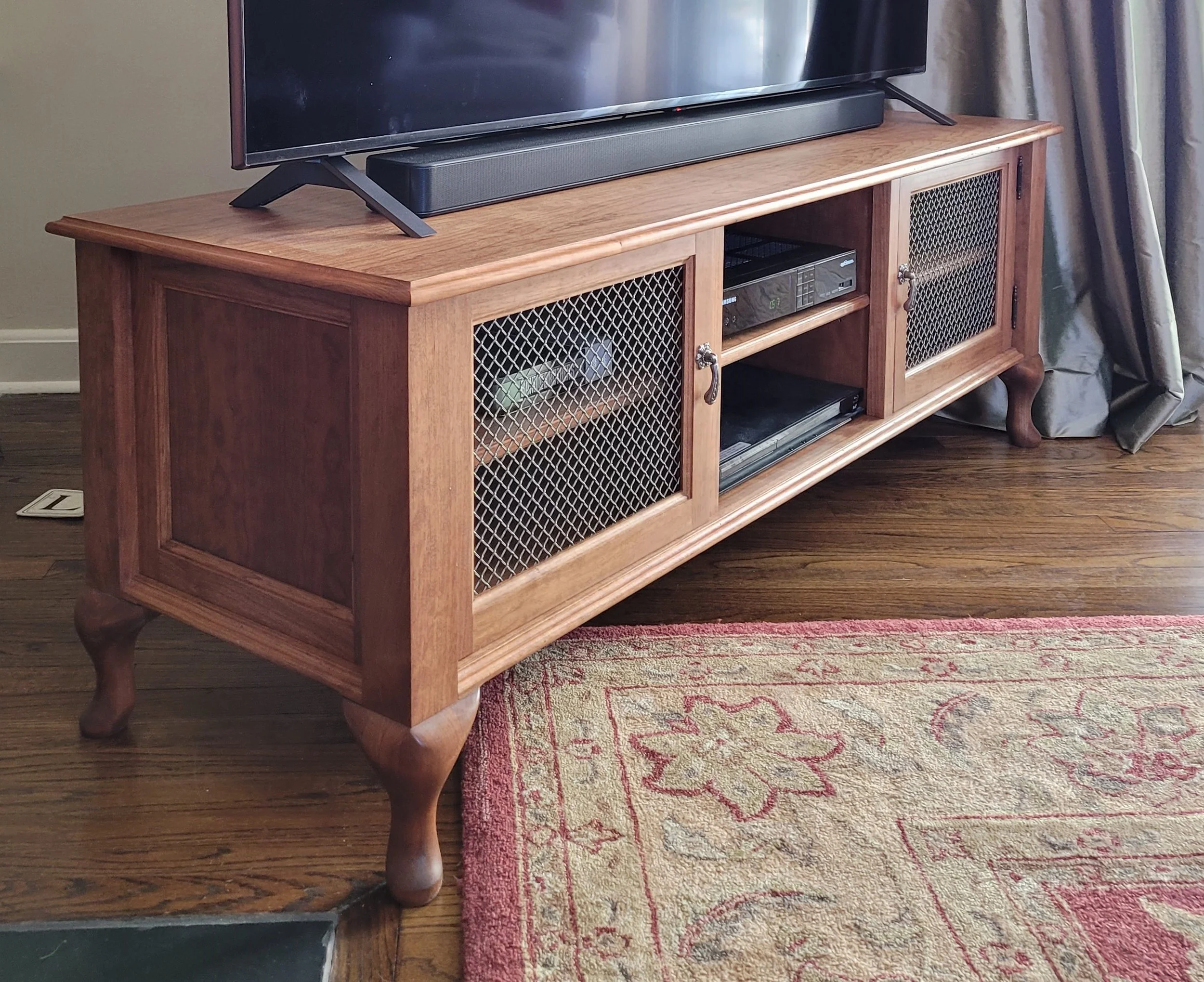
Custom TV Stand by Grayhill Woodworking LLC
For thousands of years, the gold standard for joining wood has been the mortise and tenon joint. Picture a rectangular hole cut into one piece of wood and a matching rectangular projection on another piece that fits snugly inside. Ancient Egyptians used this technique. Medieval cathedrals used it. It's proven over millennia because it's incredibly strong—when done right.
The catch? Creating traditional mortise and tenon joints by hand requires significant skill and time. As a one-person shop, I need to balance quality with the reality of how many pieces I can create.
Enter the domino system—a modern evolution I adopted a few years ago that has transformed my work. Here's how it works: Instead of hand-cutting traditional mortise and tenon joints, I use a specialized tool to create precise rectangular slots in both pieces of wood. Then I insert a pre-made wooden tenon (called a domino) with glue. The result? A joint that rivals traditional mortise and tenon strength but allows me to work more efficiently without sacrificing quality.
Why does this matter to you? Because when you buy a TV stand or side table from me, you're getting furniture built with joinery techniques that have proven themselves over centuries. That table won't wobble in two years. The legs won't loosen. It's engineered to be passed down.
I use dominos extensively in any piece where joints need to support weight or withstand stress. They create rotation-resistant connections that keep furniture square and stable. They penetrate deep into the wood—sometimes over two inches—creating exceptional glue surface area and mechanical strength.
This is heirloom-quality joinery that looks as good as it performs.
But What About Those "Assemble Yourself" Pieces?
Let's talk about what you often find in mass-produced furniture: dowel joints.
Dowels are simple wooden pegs that fit into drilled holes. You've probably assembled furniture that came with a bag of dowels and some wood glue. They're not bad—dowels can actually be quite strong when done properly. But here's the issue: mass producers often use them because they're cheap and fast, not because they're the best choice for that specific application.
In "assemble yourself" furniture, dowels are often under-sized, poorly fitted, or placed in ways that prioritize easy shipping over long-term durability. That's why your bookshelf starts leaning after a few moves or your dresser develops a wobble.
When I use dowels (which I occasionally do for specific applications), I'm using premium hardwood dowels, precisely sized, with multiple dowels per joint and proper glue coverage. But honestly? For most furniture, domino joints give me better strength with more precision, especially when working with the unique characteristics of reclaimed wood.
Here's the comparison in simple terms:
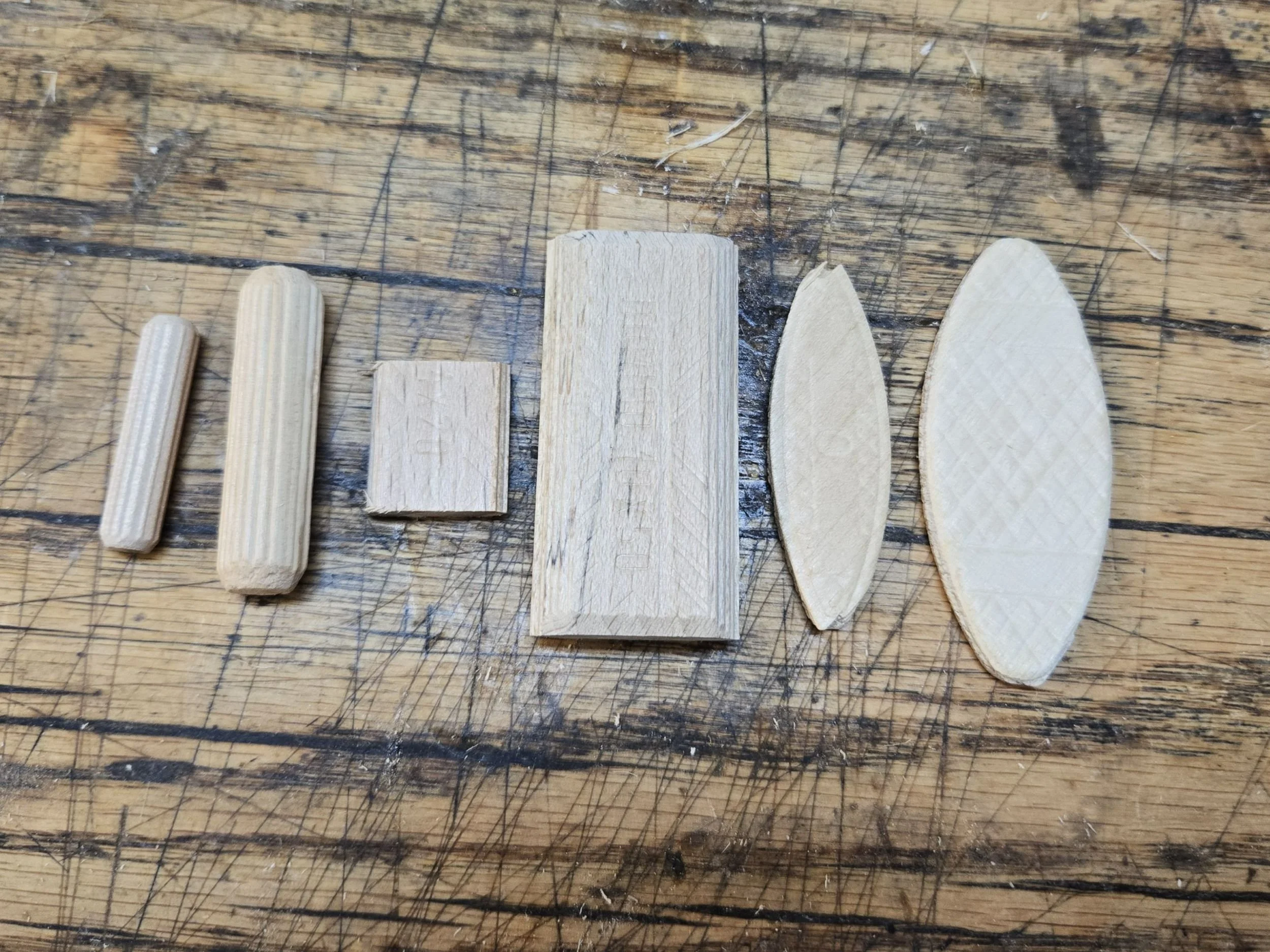
Biscuits: Perfect for keeping surfaces flat and aligned. Not about strength—about precision. Great for tabletops, serving boards, panels.
Dowels: Can be strong when done right, but often used in mass production as a cost-cutting measure. Common in furniture you assemble yourself.
Dominos (Modern Mortise & Tenon): The structural powerhouse. Deep penetration, exceptional strength, rotation-resistant. What you want in furniture that bears weight and lasts generations.
What to Ask Before You Buy
Here's where I want to empower you: the next time you're shopping for furniture or wooden home decor—whether from me or anyone else—ask these questions:
1. "How is the wood joined together?"
This is the most important question. If the seller can't answer or says "just glue," that's a red flag. Quality makers will proudly explain their joinery methods because we know it's what makes our work superior.
2. “What's underneath the surface—is this genuine solid wood construction throughout?”
There's a place for veneer, but you should know what you're buying. Solid wood can be repaired and refinished. Particle board and/or MDF (medium density fiber board) has a limited lifespan.
3. "How will this piece hold up over time?"
Listen for specifics about wood movement, finish durability, and joint strength. Vague answers suggest the maker hasn't thought about longevity.
4. "What makes your piece worth the investment?"
A quality maker should be able to articulate why their work costs more. It's not just about the time—it's about the techniques, materials, and built-to-last construction.
The Real Difference: Mass Production vs. Handcrafted
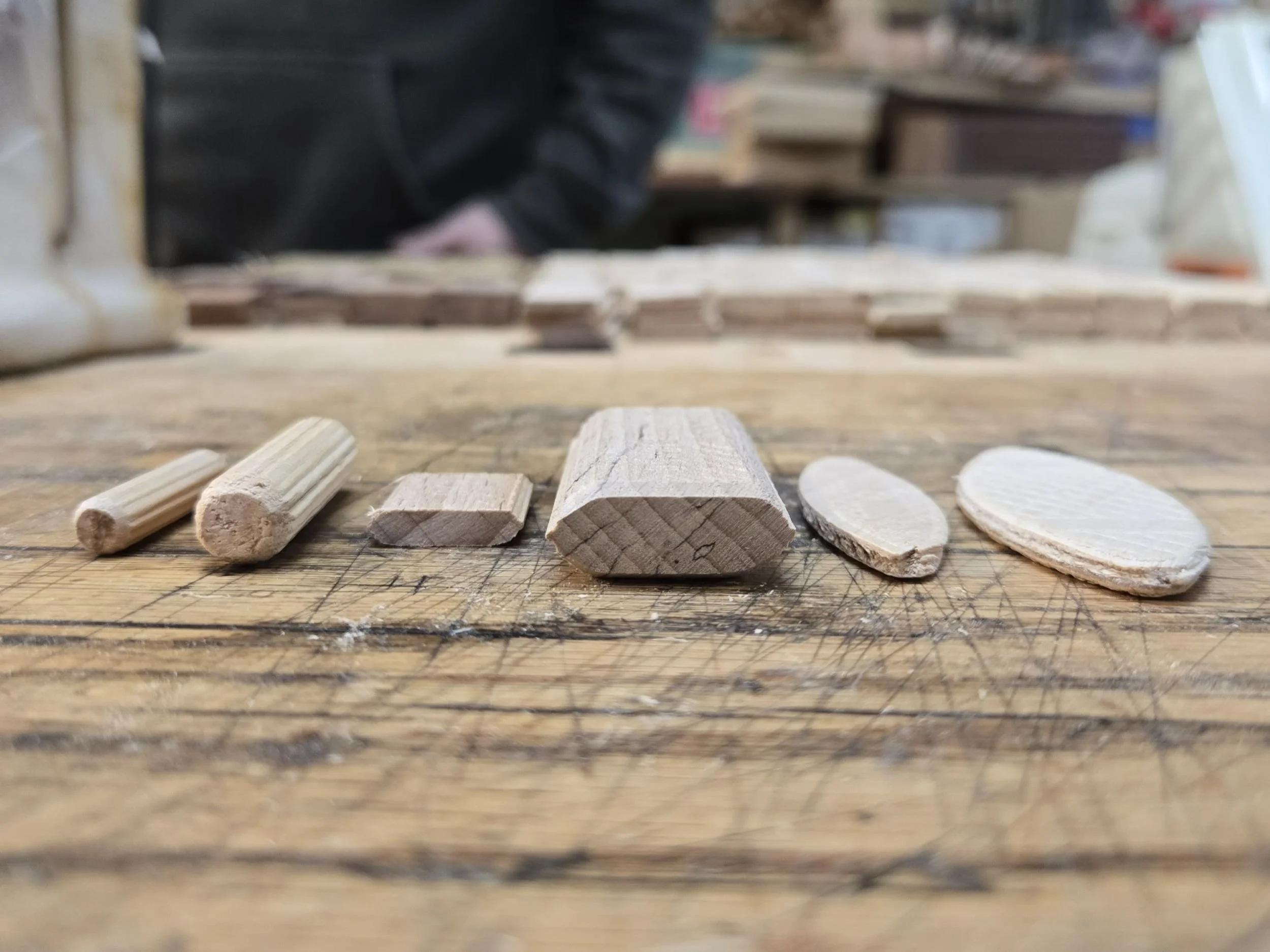
L to R: Dowel, Domino and Biscuit
Let me be honest about something: mass-produced furniture will almost always be cheaper than what I make. Economies of scale are real. Factories can crank out hundreds of identical pieces with assembly-line efficiency.
But here's what you're not getting with mass production:
Uniqueness: Every piece I create has character. The wood grain tells a story. Natural features like knots, color variations, and patterns make each item one-of-a-kind.
Quality Materials: I work with sustainably sourced and reclaimed wood, carefully selected for beauty and integrity. Mass producers optimize for cost, not character.
Craftsmanship: I'm not racing to meet production quotas. I'm building pieces I'm proud to sign.
Longevity: This is where joinery makes all the difference. I build with techniques designed for pieces to last lifetimes, not just survive shipping.
Some of my work—like end grain cutting boards—actually competes with mass-market pricing. Why? Because big retailers have set high market prices on trendy items, often taking substantial margins. My lower overhead and direct-to-customer model means I can offer comparable pricing for a unique, higher-quality piece.
But for custom furniture? I can't compete on price with a factory, and I don't try to. The value proposition is entirely different.
The Five-Year Test
I have customers who come back years after their purchase to tell me their piece still looks as beautiful as the day they received it. A cutting board that's been used weekly for five years and shows little to no wear. A serving tray that's been to countless gatherings and still draws compliments. A side table that's been moved three times and never developed a wobble.
This is what proper joinery delivers.
Meanwhile, I've seen mass-produced pieces fail within months. Joints separate. Surfaces warp. Finishes deteriorate. Not because wood is unreliable—because the construction methods prioritized speed and cost over lasting quality.
Why I'm Telling You All This
You might wonder why I'm sharing the "secrets" of my craft. Doesn't this just help people judge my work more critically?
Actually, that's exactly what I want.
I want you to be an informed buyer. I want you to look at any wooden piece—mine or someone else's—and ask the right questions. I want you to understand why quality costs what it does and why it's worth it.
Because when people understand craftsmanship, they make better purchasing decisions. They stop chasing the lowest price and start seeking the best value. They invest in pieces they'll love for decades instead of replacing cheap furniture every few years.
And honestly? That's better for everyone—for you, for makers like me, and for the planet.
The Bottom Line: What Dominos and Biscuits Mean for Your Home
So, what if dominos aren't just for games and biscuits are more than snacks?
It means that the furniture and home decor pieces in your life are built with far more sophistication than you might have realized. It means that techniques with playful names—biscuits, dominos—represent the difference between pieces that survive and pieces that endure.
When you run your hand across a perfectly smooth tabletop, that's biscuit joinery keeping every board aligned.
When your side table never wobbles, no matter how many times you've moved, that's domino joinery creating structural integrity that lasts.
When your cutting board is still beautiful after years of daily use, that's craftsmanship that values longevity over speed.
These aren't just construction methods—they're commitments. A commitment to building things the right way, even when shortcuts would be easier. A commitment to creating pieces worthy of being passed down. A commitment to the belief that what we make should outlast us.
The next time you're shopping for wood furniture or home decor, I hope you'll remember this conversation. Look beyond the price tag. Ask about the joinery. Examine the materials. Consider not just what something costs today, but what it's worth tomorrow—and twenty years from tomorrow.
Because in a world of disposable everything, there's something deeply satisfying about owning pieces built to last a lifetime.
And that's worth investing in.
Have questions about how a specific piece is constructed? Want to understand more about what makes quality furniture last? I'm always happy to talk about the craft behind the work. Because informed buyers become satisfied owners of pieces they'll treasure for decades.
Gray Hill Woodworking LLC specializes in handcrafted, functional art created from locally and sustainably reclaimed wood. Each piece is unique and one-of-a-kind, celebrating the natural beauty and character found in rescued materials throughout New Jersey, Pennsylvania, New York, and Maryland.